Benchmarking Strands Decider: multi-question latency and prefix caching
Measuring Strands Decider 2B across 1 to 128 questions on a single state. How shared-prefix caching scales, where it saves tokens, and what marginal questions cost.
Decision models evaluate typed predicates directly without autoregressive text generation. A core architectural argument for this class of model is amortized multi-question evaluation: encoding a document once, then scoring multiple questions in parallel against the cached representation.
To evaluate how this scales in practice, I benchmarked Strands Decider 2B across 1 to 128 questions over a single document, comparing its shared-prefix cache against a naive re-encoding baseline. The benchmark code and data are available on GitHub.
Benchmark setup
- State: A 2,201-token synthetic service specification covering 48 services, each detailing route, authentication, rate limits, ownership, and latency targets.
- Questions: 128 typed yes/no questions (
NoulQuestion) evaluating service properties. - Paths tested:
- Shared prefix (
use_prefix_cache=True, default): Encodes the state once per batch (defaultmax_batch=32), broadcasting the cached key-value states to evaluate question suffixes. - Naive re-encode (
use_prefix_cache=False): Concatenates state and question for each query, re-encoding the full prompt every time.
- Shared prefix (
- Metrics: Median wall-clock latency across repeated runs and input token counts reported by the model engine.
- Environment: Apple M3 Pro (MPS backend). The hybrid torso runs its reference implementation because
causal_conv1dis not installed, so absolute latencies are conservative. The token model and relative ratios remain hardware-independent.
Latency and token scaling
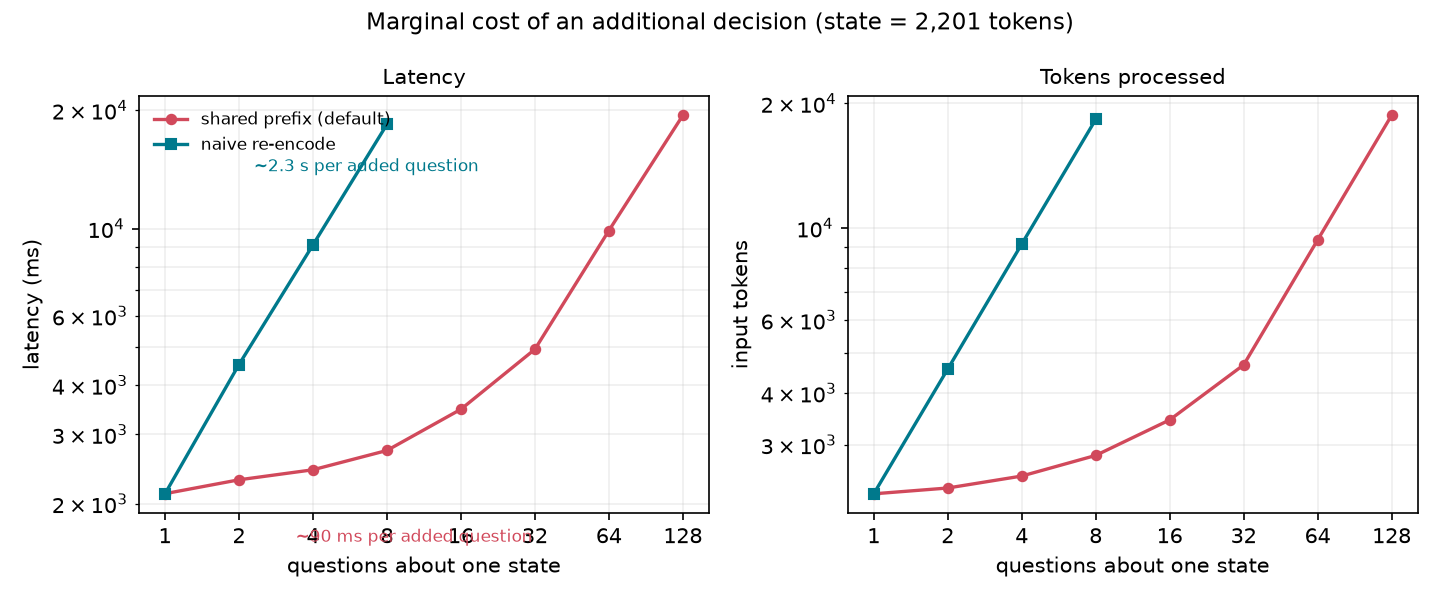
| Questions | Shared prefix (ms) | Naive re-encode (ms) | Shared tokens | Naive tokens |
|---|---|---|---|---|
| 1 | 2,120 | 2,118 | 2,283 | 2,283 |
| 2 | 2,299 | 4,514 | 2,358 | 4,568 |
| 4 | 2,438 | 9,093 | 2,520 | 9,150 |
| 8 | 2,730 | 18,413 | 2,826 | 18,296 |
| 16 | 3,474 | (not run) | 3,443 | (not run) |
| 32 | 4,936 | (not run) | 4,675 | (not run) |
| 64 | 9,889 | (not run) | 9,363 | (not run) |
| 128 | 19,414 | (not run) | 18,722 | (not run) |
Token accounting
The observed token usage follows a predictable piecewise model:
naive(n)  = n * (state + question)
          = n * 2,278

shared(n) = ceil(n / 32) * state + n * question
          = ceil(n / 32) * 2,201 + n * 77.5
The shared-prefix path eliminates redundant re-encoding of the 2,201-token state for every question within a batch. At n = 8, this reduces processed tokens from 18,296 to 2,826 (a 6.5x reduction), which directly translates to a 6.7x reduction in wall-clock latency (2.73 s vs. 18.41 s).
Marginal cost per question
While prefix caching provides substantial throughput gains, marginal questions are not free:
- Within a batch: Adding a question costs approximately 90 ms in the shared path versus approximately 2.3 s in the naive path (a 25x difference). Each suffix must still attend across the 2,201-token cached state, so execution time grows with question count even before re-encoding.
- Across batch boundaries: The engine enforces a batch ceiling (
max_batch=32) to bound memory during KV-cache broadcast. When crossing batch boundaries (n = 33, 65, 97), the state must be re-encoded for the new batch. This produces step increases in latency at 32, 64, and 128 questions.
Conclusion
The multi-question efficiency of decision models is real and significant: 6.7x speedup at 8 questions, scaling to more than 15x asymptotically as question count increases. However, the performance profile is determined by batch boundaries and attention over the cached prefix rather than zero-marginal-cost scaling. Systems relying on high-volume evaluation batteries should align query batches with the engine's batch limit.
All benchmark scripts, raw JSON outputs, and plotting code are available at swopnilnep/strands-decider-benchmark.